







FFP3 Mask Production Line: Installation & Maintenance Tips
Source:https://www.loymachine.comDate:2026-11-04
FFP3 masks are high-performance respiratory protective devices designed to filter at least 99% of airborne particles, including viruses, bacteria, and fine dust. As demand for these masks has grown, so has the adoption of automated production lines that combine nonwoven feeding, folding, nose-wire insertion, ultrasonic welding, and cutting into a continuous process. However, the performance of an FFP3 mask depends as much on the reliability of the production equipment as on the raw materials. Poor installation and neglected maintenance can lead to mask leakage, weak weld seams, misaligned nose wires, and inconsistent filtration efficiency. This article outlines practical installation and maintenance tips for FFP3 mask production lines, helping manufacturers achieve stable output, reduce downtime, and maintain compliance with EN 149 or equivalent standards.
Installation begins with site preparation and machine leveling. FFP3 lines are sensitive to vibration and dust, so the equipment should be placed on a solid, level floor in a clean, temperature- and humidity-controlled room; excessive humidity can affect the electrostatic charge of meltblown filter media. Before assembly, verify that the power supply, compressed air, and ultrasonic generators meet the manufacturer's specifications. Level each module—unwinder, folding unit, welding stations, and cutter—using precision levels, and align them with a laser or tensioned wire to ensure the nonwoven web travels in a straight path. Pay particular attention to the tension control system on the material unwinder: uneven tension causes wrinkles and edge curling that later translate into poor mask fit. When connecting the ultrasonic welding units, set the horn-to-anvil gap precisely according to the manual and confirm that the generator frequency matches the transducer. Finally, run the line empty for several minutes, then feed scrap material to check web tracking, cutting accuracy, and weld quality before producing salable masks. Commissioning should include a trial batch tested for particle filtration efficiency (PFE) and breathing resistance, since these results confirm that installation settings are correct.
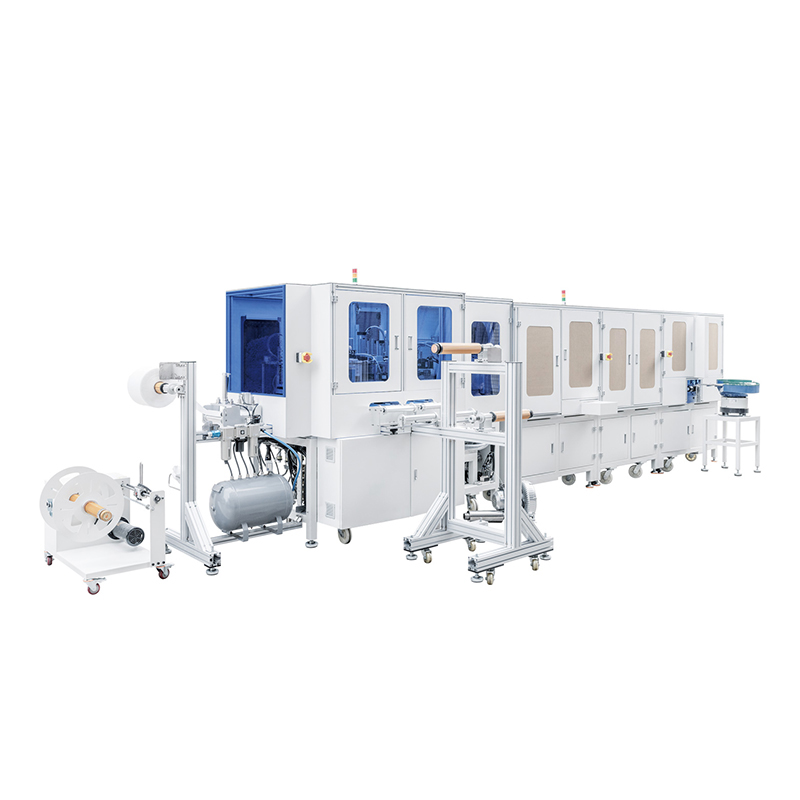
Routine maintenance is the foundation of consistent FFP3 quality. Establish a daily checklist that covers cleaning of the folding rollers and cutting blades, inspection of the ultrasonic horns for wear or buildup, checking of the nose-wire feeding mechanism for jams, and verification of air pressure and filter condition. Worn or contaminated ultrasonic horns produce weak welds that can cause ear-loop detachment or edge separation, so horns should be cleaned with a soft brush and inspected for cracks at regular intervals. Blades should be sharpened or replaced according to a schedule based on production volume; dull blades create frayed edges that compromise mask integrity. Lubricate moving parts such as bearings and linear guides with the lubricant specified by the manufacturer, and avoid over-lubrication, which attracts dust. Keep the meltblown and nonwoven materials stored in sealed packaging away from moisture and direct sunlight, and load rolls only after they have acclimated to the production environment. In addition, maintain a spare-parts inventory for high-wear items—belts, blades, horns, sensors, and solenoid valves—so that minor failures do not escalate into long stoppages.
Beyond daily tasks, scheduled preventive maintenance and documentation are essential. Weekly checks should include calibration of tension sensors, inspection of electrical connections, and testing of safety interlocks and emergency stops. Monthly maintenance can cover replacement of air filters, verification of ultrasonic generator output, and a full alignment check of the web path. Keep detailed records of every maintenance action, including date, component, and observations, because this data helps identify recurring faults and supports traceability requirements for personal protective equipment. Train operators to recognize early warning signs—unusual noise, inconsistent weld strength, drifting cut dimensions, or increased rejection rates—and to report them promptly. Finally, consider environmental controls: stable temperature and humidity, filtered air, and effective dust extraction around the cutting section all extend equipment life and protect the filtration performance of the finished FFP3 masks. With disciplined installation and a structured maintenance program, a production line can deliver reliable output and masks that consistently meet stringent protection standards.
Recommended News
-
FFP3 Mask Production Line: Installation & Maintenance Tips
Practical tips for installing and maintaining FFP3 mask production lines to ensure stable output, reduce downtime, and meet EN 149 standards.
2026-11-04 09:53:42 -
What points should be kept in mind when maintaining a production line for disposable masks?
Disposable mask production lines are high-speed, continuously operating automated systems; the quality of daily maintenance directly determines production stability and product yield. Once equipment is put into operation, many enterprises focus exclusively on orders and raw materials, neglecting pro
2026-11-03 15:23:43 -
Five Key Points for the Daily Maintenance of Flat Mask-Making Machines
The maintenance of flat-mask manufacturing machines directly impacts production capacity and product yield. This article outlines key points for daily inspection—covering cleaning, lubrication, management of wear-prone parts, checks of electrical and pneumatic systems, and operational standards—to help factories reduce failure rates and extend equipment lifespan.
2026-10-31 09:48:32 -
Guide to Improving Process Stability for Cup-Style Mask-Making Machines
This document analyzes common issues contributing to production instability in cup-style mask-making machines. It provides systematic solutions—covering equipment installation and commissioning, ultrasonic welding calibration, material consistency management, standardization of process parameters, and environmental temperature and humidity control—to help enterprises enhance production capacity, yield rates, and operational stability.
2026-10-30 13:33:22