






What should I check when using a fully automatic mask machine?
Source:http://www.loymachine.comDate:2025-09-25
The transmission system of a fully automatic mask machine is relatively complex. It primarily includes the ultrasonic system, air supply system, and electrical system. If any of these components malfunction, the entire machine may not start or operate properly. Before using the machine, check the following items.
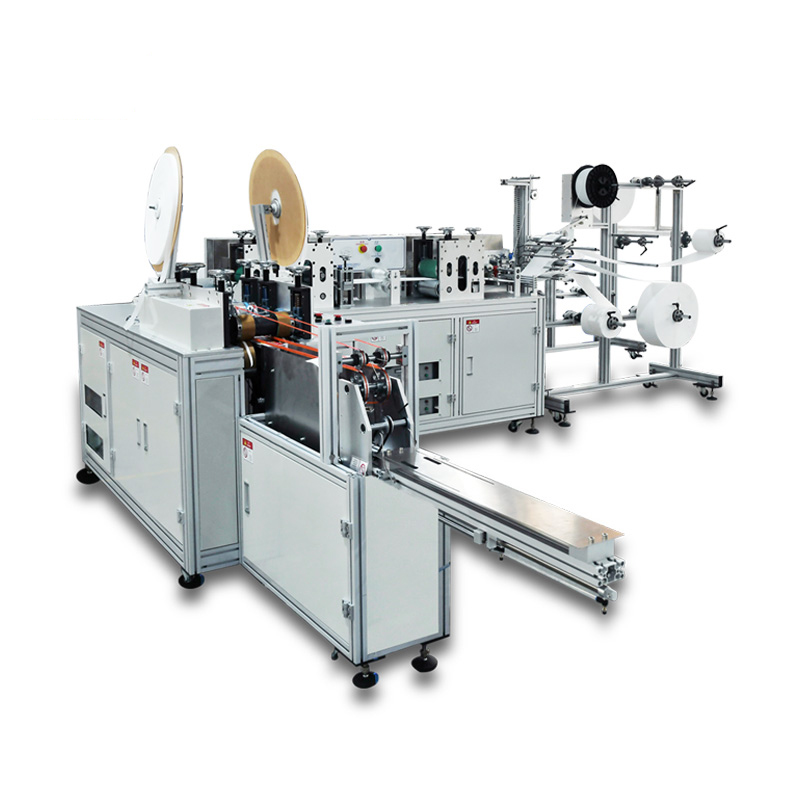
First, the mask machine's electrical system, primarily consisting of components such as wiring and connectors. Check for loose connectors, aging or damage to power and signal cables, dust in the electrical box, and proper heat dissipation from the exhaust fan.
Second, check the machine's ultrasonic system. This system primarily consists of welding pins, an ultrasonic generator, alignment wires, and transducers. During this inspection, primarily check the ultrasonic system for cleanliness. Clean the ultrasonic generator, transducer, and welding pins appropriately to remove any dirt, but be careful to avoid any residual water. Additionally, ensure that wiring is securely fastened and that the voltmeter and ammeter on the ultrasonic generator are functioning properly to prevent potential safety issues with the machine.
Third, check the machine's air supply system. This section primarily consists of the air filter, cylinder, and bronchial tube. Check for water in the air filter cup, add water to the air compressor as needed, and inspect the bronchial tube and cylinder for leaks.
These are several areas you should check before using a fully automatic mask machine. Failure to properly install and configure the machine before use can lead to adverse consequences, disrupting factory production and potentially causing accidents.
Recommended News
-
Future Prospects of N95 Masks: Insights from a Leading N95 Mask Machine Manufacturer
As a trusted manufacturer of N95 mask production machinery, we have witnessed firsthand the dramatic evolution of the respiratory protection industry over the past few years. From a niche product used primarily in healthcare settings, the N95 mask has become a global essential. Now, as the initial surge of pandemic-driven demand stabilizes, many are asking: What does the future hold for N95 masks?In this article, we share our perspective on the long-term prospects of N95 masks, based on market trends, technological advancements, and evolving public health awareness.#### Sustained Demand Beyond the PandemicWhile emergency stockpiling has decreased, the underlying demand for high-filtration masks remains strong. Several factors contribute to this sustained interest:- **Heightened Health Awar
2026-09-02 08:11:25 -
Customizable Flat Mask Machine: Tailoring Solutions for Global Protection Needs
As global health and safety standards continue to evolve, the demand for disposable flat masks has become increasingly diversified. Modern automatic flat mask making machines have transitioned from simple mass-production tools to highly flexible manufacturing platforms. By utilizing modular designs, manufacturers can easily customize equipment to meet specific market requirements across medical, industrial, and daily protection sectors. Below is a comprehensive overview of the key customization options available for flat mask machines.Versatile Earloop and Tying OptionsThe wearing style of a mask dictates its application and sealing performance. While standard flat mask machines typically produce outer earloop masks, modular expansions allow for seamless transitions to various configuratio
2026-08-25 08:26:48 -
FFP3 mask machine manufacturers explain: What are FFP3 masks used for?
When it comes to high-level respiratory protection in European safety standards, FFP3 masks stand out as the most reliable barrier against ultra-fine harmful particles. Many users confuse FFP3 masks with ordinary disposable masks or FFP1/FFP2 protective masks, unaware of their unique protection level and exclusive application scenarios. As professional FFP3 mask machine manufacturers, we will systematically explain the core functions, protection advantages and main uses of FFP3 masks to help you accurately match protective equipment for different high-risk environments.Basic Overview: What Is an FFP3 Mask?FFP3 (Filtering Face Piece 3) is the highest-grade particulate filtering half-mask under the European EN 149 standard, belonging to the core category of professional respiratory protectiv
2026-07-28 08:27:45 -
N95 Mask Machine: Core Automatic Equipment for High-Efficiency Protective Mask Production
N95 Mask Machine: Core Automatic Equipment for High-Efficiency Protective Mask ProductionWidely applied in public health protection, industrial dust prevention, medical protection and other fields, N95 masks have become essential protective supplies thanks to their excellent particulate filtration performance. The N95 mask machine is an intelligent automatic production line specially designed for mass and standardized production of folded N95 protective masks. Adopting precision mechanical transmission, ultrasonic welding and intelligent electronic control system, it realizes fully automatic operations from raw material processing to finished mask output, serving as the core key equipment for protective mask manufacturers.Different from ordinary flat mask machines, the N95 mask machine is
2026-07-24 08:55:50