





Composition of Flat Mask Production Line Machines
Source:http://www.loymachine.comDate:2026-05-07
A flat mask production line is not a single machine, but a combination of multiple specialized equipment working together in coordination. It follows the process of "raw material processing → mask body forming → earloop welding → inspection and packaging". The core machines can be divided into two categories: main line equipment and auxiliary equipment. Currently, the mainstream configuration in the industry is the one-to-one production line, which has a unified and mature equipment configuration. The details are as follows:
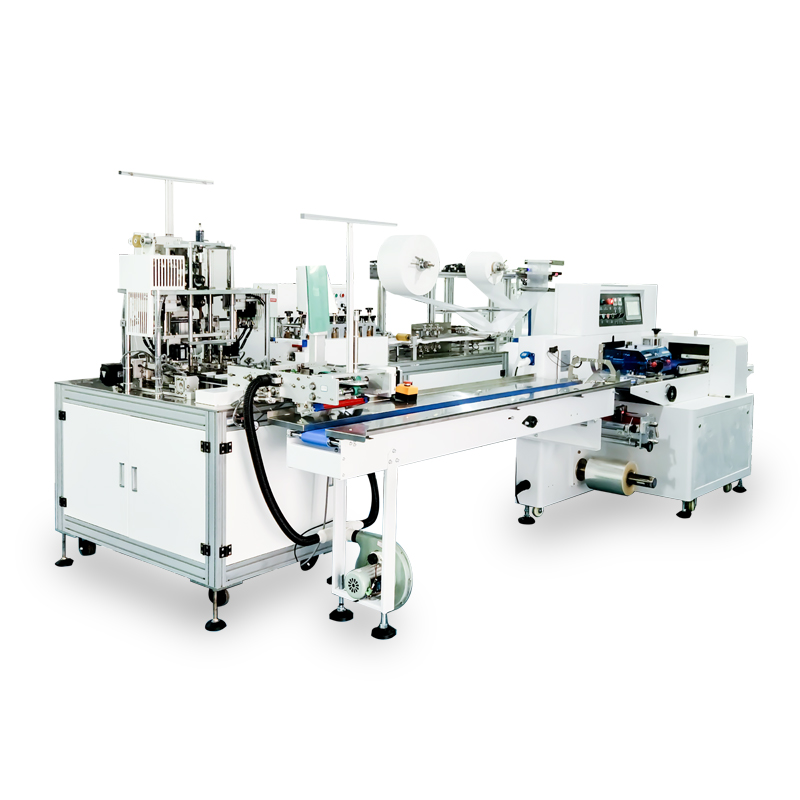
I. Core Main Line Equipment (Necessary, Determining the Integrity of the Production Process)
1. Mask Body Making Machine (Mask Forming Machine)
As the core basic equipment of the production line, it is responsible for processing multiple layers of non-woven fabrics (such as spunbonded fabric and meltblown fabric) into mask bodies. It is the first key process in flat mask production and the common core equipment for one-to-one production lines. Its core functions include:
Raw Material Feeding: Equipped with a raw material frame, it can realize synchronous unwinding of 2-4 layers of PP non-woven fabrics and composite fiber materials. Some high-end models are equipped with an automatic deviation correction and tension device to ensure smooth transportation of raw materials and avoid deviation;
Folding and Pressing: The multi-layer raw materials are folded and formed through a folding mechanism, and edge sealing and embossing welding are completed at the same time to ensure that the layers of the mask body are closely attached and the edges are flat;
Nose Wire Processing: Built-in nose wire feeding mechanism, which can automatically complete the traction and fixed-length cutting of the nose wire, and accurately embed it into the corresponding position of the mask body to achieve firm bonding between the nose wire and the non-woven fabric. Some models support one-click switching of nose wire length;
Slitting and Forming: The continuous fabric is cut into individual mask bodies through a slitting mechanism with high cutting precision. The mask size can be adjusted according to needs (such as one-click switching between 125mm-230mm), and the leftover material is collected at the same time to reduce raw material waste.
High-end mask body making machines mostly adopt full servo drive and are equipped with a PLC touch control system, which can realize functions such as production parameter adjustment and output statistics. The production speed can reach 70-100 pieces per minute, and some models can be increased to more than 120 pieces per minute, with stronger stability and more convenient operation.
2. Earloop Welding Machine (Divided into Inner Earloop, Outer Earloop and Tie-on Types)
It takes over the mask bodies produced by the mask body making machine and completes the welding and fixing of the earloops. It is a key subsequent equipment for flat mask forming. Currently, the mainstream in the industry is the one-to-one production line, with one earloop welding machine matched with each mask body making machine. The corresponding model can be selected according to the mask type. The core functions and classifications are as follows:
Outer Earloop Mask Machine: It fuses the elastic band to both sides of the mask body by ultrasonic welding. Only one operator is needed to place the mask body, and the subsequent welding, cutting and finished product output are all completed automatically. It has a high output (100-120 pieces per minute), small machine volume, PLC program control and strong stability. Some models support the outer ear inner folding function and can produce two types of products;
Inner Earloop Mask Machine: The earloops are implanted or pasted on the inner side of the mask body through ultrasonic vibration. After welding, the earloops are not exposed, making them more comfortable to wear. It also realizes automatic operation. It only needs manual placement of the mask body, and the subsequent processes are completed automatically. The welding strength is adjustable, which is suitable for earloop materials of different thicknesses, with an output of 100-120 pieces per minute;
Tie-on Mask Machine: It uses ultrasonic welding to press and cut the tie-on straps with the mask body. It is suitable for flat masks that need to be fixed with tie-on straps. It has high automation. It only needs manual feeding and finishing of finished products, which can effectively control the deviation of finished product size and save raw materials, with an output of 80-90 pieces per minute.
All earloop welding machines are equipped with an earloop feeding mechanism and an ultrasonic welding component, with stable welding quality. The welding strength can be adjusted according to needs. Some high-end models are equipped with a turning mechanism to ensure the symmetrical and accurate position of earloop welding.
3. Finished Product Inspection and Packaging Equipment
After the welding of the mask body and earloops is completed, inspection and packaging equipment are required to ensure the qualification of products and facilitate storage and transportation. It is the final core equipment of the production line. Some automatic production lines have realized the integration of inspection and packaging:
Inspection Equipment: The mainstream configuration is a CCD visual inspection device, which can automatically detect whether the earloop welding of the mask is firm, whether there is missing welding, whether the nose wire is missing, and whether the mask size meets the standard. At the same time, it automatically rejects unqualified products to ensure the qualified rate of finished products. Some models can realize the classification and statistics of production faults, which is convenient for equipment maintenance;
Packaging Machine: It is divided into semi-automatic and fully automatic types. The fully automatic packaging machine can realize automatic material taking, bagging, sealing and coding (production date, batch number) of masks. Some models can also complete the weighing inspection after packaging. The packaging method is mainly bag packaging, which is suitable for finished masks of different specifications; The semi-automatic packaging machine needs manual auxiliary feeding to complete sealing, coding and other processes, which is suitable for small production lines or scenarios with low output demand.
II. Auxiliary Equipment (Optional, Improving Production Efficiency, Product Quality and Safety)
Ion Wind Anti-static Equipment: Installed in the raw material feeding link of the mask body making machine, it is used to remove static electricity on the surface of non-woven fabrics and meltblown fabrics, avoid raw materials absorbing dust and hair due to static electricity, prevent raw material adhesion, ensure smooth transportation of raw materials, and improve the cleanliness and production stability of the mask body. It is a common auxiliary equipment for high-end production lines;
Automatic Raw Material Splicing Machine: When the raw material rolls such as non-woven fabrics and meltblown fabrics are about to be used up, it can automatically splice the end of the new raw material roll with the old one, without stopping the machine for material change, effectively reducing the production interruption time and improving production efficiency. Some models support the automatic splicing design of 6 layers of materials;
Waste Collection Device: Matched with the slitting mechanism of the mask body making machine, it is used to collect the leftover materials generated during the mask slitting process, facilitate subsequent recycling, reduce raw material waste, and keep the production environment clean. Some models can realize automatic collection and sorting of leftover materials;
Electric Control and Conveying Auxiliary Equipment: Including PLC control system, touch operation screen, automatic conveying system, etc. The PLC control system can realize the linkage control of the whole line of equipment, support functions such as production parameter adjustment, output statistics and fault alarm. The touch screen adopts Chinese and English interfaces, which is convenient to operate; The automatic conveying system runs through the entire production line, responsible for the transportation of materials between various equipment to ensure the continuity of the production process. Some production lines are equipped with a blanking conveying line to realize automatic stacking and transportation of finished products.
III. Summary of Core Configuration of the Production Line
1. Basic Simple Production Line (Semi-automatic): Mask Body Making Machine + Semi-automatic Earloop Welding Machine + Manual Inspection + Semi-automatic Packaging Machine. It is suitable for small enterprises or scenarios with low output demand. It requires 2-3 operators and has relatively low production efficiency;
2. Fully Automatic Production Line (One-to-one): Mask Body Making Machine + Fully Automatic Earloop Welding Machine + CCD Visual Inspection Equipment + Fully Automatic Packaging Machine + Auxiliary Equipment (Ion Wind Anti-static, Raw Material Splicing, etc.). It realizes the whole process automation from raw materials to finished products, requiring only 1-2 operators. The output of the earloop welding machine can reach 80-120 pieces per minute, and the production speed of the mask body making machine can be matched synchronously, with considerable daily output and a qualified rate of 99%. It is the current mainstream production configuration, adopting modular design, with safe and simple operation, convenient maintenance, automatic shutdown alarm and strong equipment stability.
Recommended News
-
Future Prospects of N95 Masks: Insights from a Leading N95 Mask Machine Manufacturer
As a trusted manufacturer of N95 mask production machinery, we have witnessed firsthand the dramatic evolution of the respiratory protection industry over the past few years. From a niche product used primarily in healthcare settings, the N95 mask has become a global essential. Now, as the initial surge of pandemic-driven demand stabilizes, many are asking: What does the future hold for N95 masks?In this article, we share our perspective on the long-term prospects of N95 masks, based on market trends, technological advancements, and evolving public health awareness.#### Sustained Demand Beyond the PandemicWhile emergency stockpiling has decreased, the underlying demand for high-filtration masks remains strong. Several factors contribute to this sustained interest:- **Heightened Health Awar
2026-09-02 08:11:25 -
Customizable Flat Mask Machine: Tailoring Solutions for Global Protection Needs
As global health and safety standards continue to evolve, the demand for disposable flat masks has become increasingly diversified. Modern automatic flat mask making machines have transitioned from simple mass-production tools to highly flexible manufacturing platforms. By utilizing modular designs, manufacturers can easily customize equipment to meet specific market requirements across medical, industrial, and daily protection sectors. Below is a comprehensive overview of the key customization options available for flat mask machines.Versatile Earloop and Tying OptionsThe wearing style of a mask dictates its application and sealing performance. While standard flat mask machines typically produce outer earloop masks, modular expansions allow for seamless transitions to various configuratio
2026-08-25 08:26:48 -
FFP3 mask machine manufacturers explain: What are FFP3 masks used for?
When it comes to high-level respiratory protection in European safety standards, FFP3 masks stand out as the most reliable barrier against ultra-fine harmful particles. Many users confuse FFP3 masks with ordinary disposable masks or FFP1/FFP2 protective masks, unaware of their unique protection level and exclusive application scenarios. As professional FFP3 mask machine manufacturers, we will systematically explain the core functions, protection advantages and main uses of FFP3 masks to help you accurately match protective equipment for different high-risk environments.Basic Overview: What Is an FFP3 Mask?FFP3 (Filtering Face Piece 3) is the highest-grade particulate filtering half-mask under the European EN 149 standard, belonging to the core category of professional respiratory protectiv
2026-07-28 08:27:45 -
N95 Mask Machine: Core Automatic Equipment for High-Efficiency Protective Mask Production
N95 Mask Machine: Core Automatic Equipment for High-Efficiency Protective Mask ProductionWidely applied in public health protection, industrial dust prevention, medical protection and other fields, N95 masks have become essential protective supplies thanks to their excellent particulate filtration performance. The N95 mask machine is an intelligent automatic production line specially designed for mass and standardized production of folded N95 protective masks. Adopting precision mechanical transmission, ultrasonic welding and intelligent electronic control system, it realizes fully automatic operations from raw material processing to finished mask output, serving as the core key equipment for protective mask manufacturers.Different from ordinary flat mask machines, the N95 mask machine is
2026-07-24 08:55:50